A simple drug stop can turn into a much bigger charge fast. One minute someone gets pulled over for a busted taillight, and the next minute police are searching the car and finding drugs. If the amount, the packaging, or what else was in the car looks a certain way, a simple possession charge can turn into possession with intent to distribute.
Possession with intent to distribute, often called PWID, is a felony in Georgia. It carries much harsher penalties than simple possession, and prosecutors do not need to prove an actual drug sale took place. They just need to convince a jury that the person planned to sell, share, or hand off the drugs to someone else. Understanding what evidence prosecutors lean on can help you understand why a case moved from possession to distribution, and where a defense might be built.
What Possession With Intent to Distribute Means in Georgia
Under Georgia law, specifically O.C.G.A. § 16-13-30(b), it is against the law to manufacture, deliver, distribute, sell, or possess a controlled substance with intent to distribute it. This law covers more than just catching someone in the act of a sale.
To win a PWID case, the prosecutor has to prove two things:
- The person possessed a controlled substance
- The person intended to distribute it to someone else
That second part is the tricky one. Nobody has to complete a sale, or even try to make one, for this charge to apply. The state only has to convince a judge or jury that the person planned to give or sell the drugs to someone else at some point.
This is different from simple possession, which only requires proof that someone had the drugs. Intent adds a whole new layer, and it’s usually built from small pieces of evidence rather than one clear fact.
How Prosecutors Try to Prove Intent
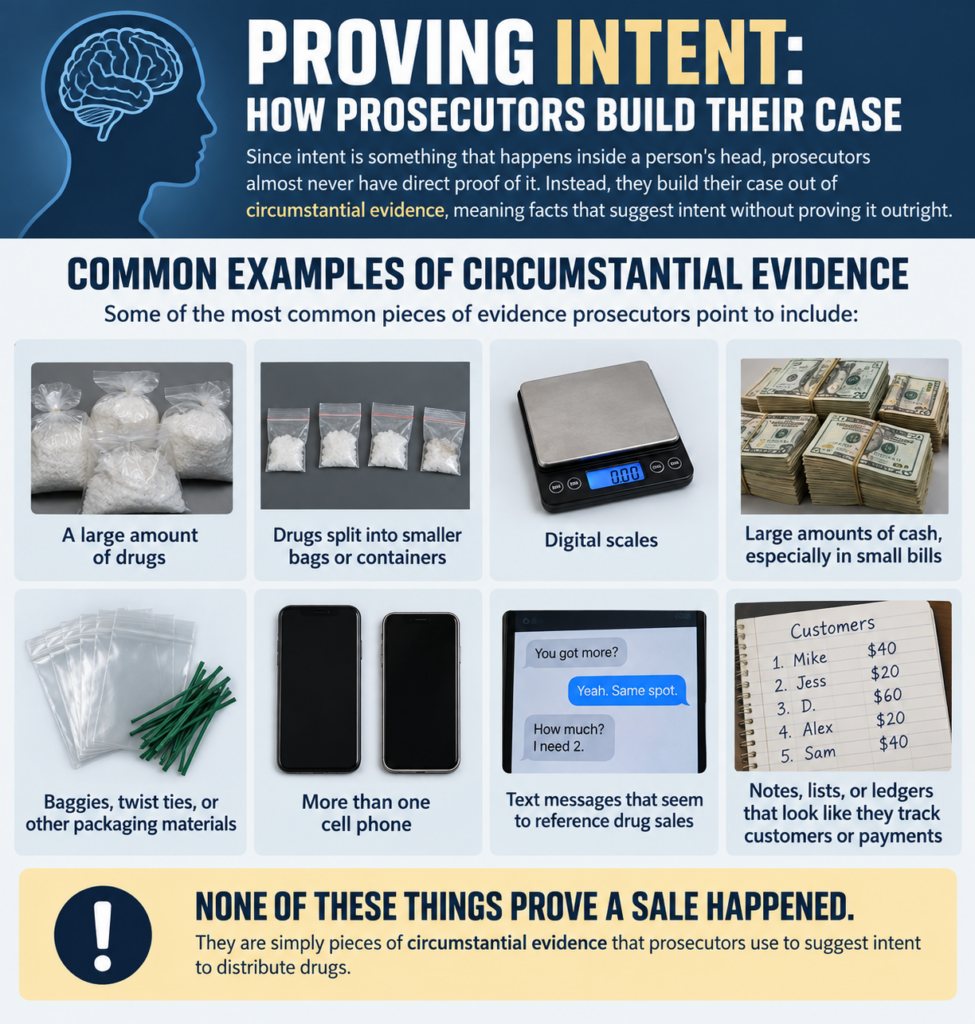
Since intent is something that happens inside a person’s head, prosecutors almost never have direct proof of it. Instead, they build their case out of circumstantial evidence, meaning facts that suggest intent without proving it outright.
Some of the most common pieces of evidence prosecutors point to include:
- A large amount of drugs
- Drugs split into smaller bags or containers
- Digital scales
- Large amounts of cash, especially in small bills
- Baggies, twist ties, or other packaging materials
- More than one cell phone
- Text messages that seem to reference drug sales
- Notes, lists, or ledgers that look like they track customers or payments
None of these things prove a sale happened. But when several of them show up together, prosecutors use that combination to build a story that points toward distribution instead of personal use.
Why the State Leans So Heavily on Circumstantial Evidence
Police rarely watch a hand to hand drug sale happen. Instead, officers search a car, house, or person and find items that could support several different explanations. The state’s job is to convince a jury that distribution is the only reasonable explanation for what was found.
This is where a defense lawyer’s job becomes important. Most of the items on that list have normal, harmless explanations too. A scale could belong to someone who works in a kitchen. Cash could come from a paycheck. Multiple phones could belong to a family that shares devices. None of it automatically means someone was selling drugs.
The Amount of Drugs Involved Matters a Lot
Quantity is one of the biggest factors prosecutors look at when deciding whether to charge simple possession or PWID.
A small amount usually looks like personal use. A larger amount, or drugs that were split into separate doses, tends to look like it was meant for distribution. Georgia does not set one specific weight that automatically triggers a PWID charge, but a few patterns tend to hold up:
- Amounts that fit typical personal use often support a simple possession charge
- Amounts well above personal use levels tend to support a PWID charge
- Amounts close to trafficking weights often lead to PWID charges being filed automatically
For example, someone with 10 grams of cocaine split into several small baggies could face a PWID charge, even though that amount is far below the 28 gram threshold that triggers a trafficking charge. It’s not just about how much was found. It’s also about how the drugs were stored and divided.
How Packaging Affects the Charge
The way drugs are packaged can carry almost as much weight as the amount found. A single bag holding all the drugs together often points toward personal use. Drugs broken up into several small, equal amounts tend to look like they were prepared for sale.
Packaging evidence prosecutors point to includes:
- Several small baggies or corner ties
- Vacuum sealed packages
- Drugs divided into roughly equal portions
- Scales that show drug residue on them
- Empty baggies or wrapping materials found nearby
Even everyday items like sandwich bags can become evidence if prosecutors believe they were used to package drugs for sale. This is one reason why a defense lawyer will often look closely at whether packaging really shows intent, or whether there’s a normal explanation for it.
Cash, Phones, and Other Red Flags
Prosecutors do not stop at the drugs themselves. They look at everything else found nearby, especially cash and phones, because those items can support the idea that a sale was happening or about to happen.
Things police and prosecutors commonly point to include:
- Cash that cannot be easily explained, especially in small bills
- Text messages that mention prices, amounts, or meeting up
- Multiple phones or SIM cards
- Contact information that looks like a customer list
- Other drug paraphernalia found at the scene
The problem is that a lot of this evidence has innocent explanations too. Someone might carry cash from a job that pays in tips. A second phone might just be an old one they never got rid of. Prosecutors tend to build a story first and then fit the evidence into it, which is exactly why each piece needs to be looked at carefully rather than taken at face value.
Penalties for Possession With Intent to Distribute in Georgia
PWID is always charged as a felony in Georgia, and the punishment can be severe.
For Schedule I or II drugs:
- First offense: 5 to 30 years in prison
- Second offense: 10 to 40 years, or even life in prison
For Schedule III, IV, or V drugs:
- 1 to 10 years in prison
On top of prison time, fines can reach as high as 1 million dollars depending on the drug involved and the amount. These numbers are far higher than what someone would face for a simple possession charge, which is exactly why the difference between the two charges matters so much.
How PWID Is Different From Drug Trafficking
People often mix up possession with intent to distribute and drug trafficking, but Georgia treats them as two separate charges with different rules.
PWID depends on circumstantial evidence like quantity, packaging, and cash to prove intent. Trafficking, under O.C.G.A. § 16-13-31, kicks in automatically once the amount of drugs crosses a specific weight, no matter what the person’s plans for the drugs were.
Georgia’s trafficking thresholds include:
- 28 grams or more of cocaine
- 4 grams or more of heroin, morphine, or opium
- 10 pounds or more of marijuana
- 28 grams or more of methamphetamine
Trafficking carries mandatory minimum sentences that a judge cannot lower, no matter the circumstances. With PWID, a judge has more room to weigh the facts of the case. That’s a big reason why the specific charge someone faces matters just as much as the amount of drugs found.
Ways to Fight a PWID Charge
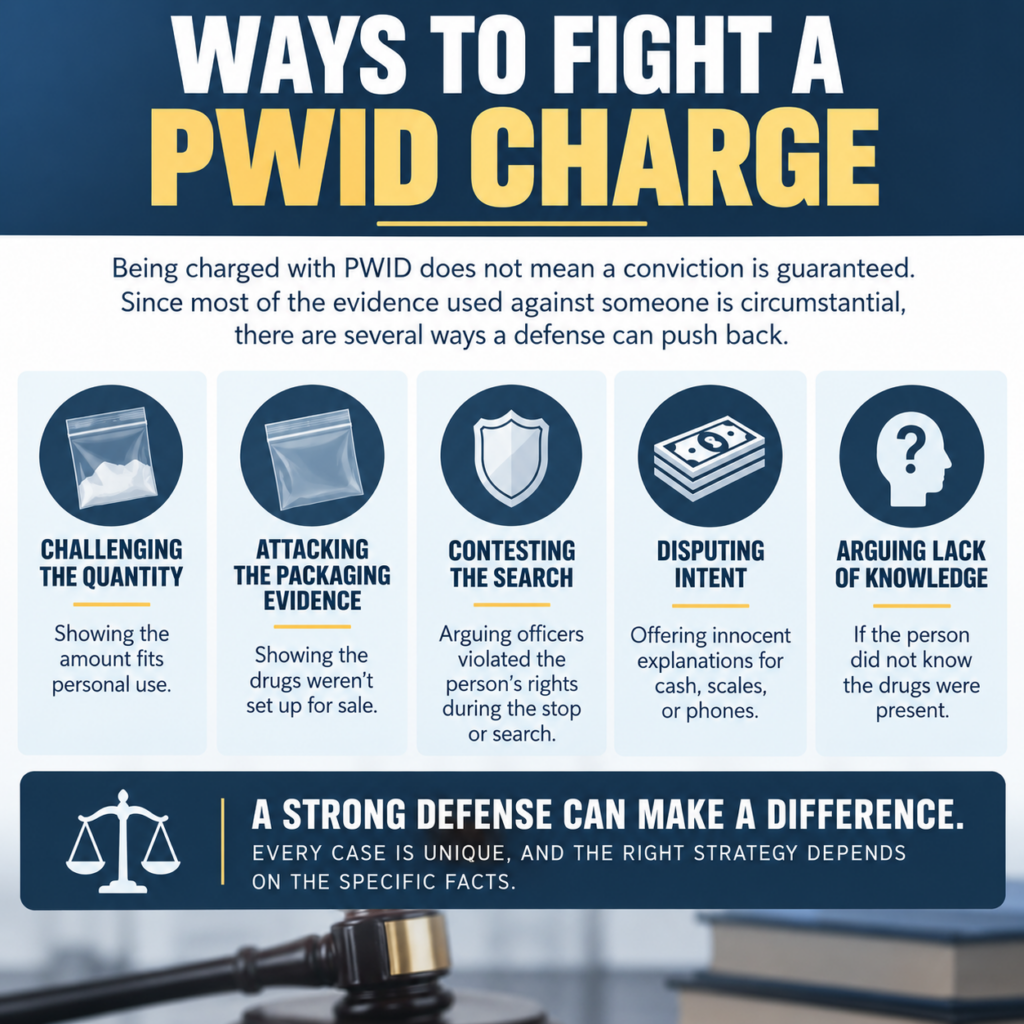
Being charged with PWID does not mean a conviction is guaranteed. Since most of the evidence used against someone is circumstantial, there are several ways a defense can push back.
Common defense strategies include:
- Challenging the quantity by showing the amount fits personal use
- Attacking the packaging evidence by showing the drugs weren’t set up for sale
- Contesting the search by arguing officers violated the person’s rights during the stop or search
- Disputing intent by offering innocent explanations for cash, scales, or phones
- Arguing lack of knowledge if the person did not know the drugs were present
In many cases, a defense lawyer can negotiate the charge down to simple possession, which comes with far lower penalties. The key is picking apart the state’s story piece by piece instead of accepting the label the police gave the case.
Why Lab Testing Matters in These Cases
Before anyone can be convicted, the state has to prove that what they found was actually a controlled substance. This usually means the drugs get sent to a crime lab for testing.
Without solid lab results, the state has a much harder time proving its case. Lab testing can be challenged in a few ways:
- Problems with chain of custody, meaning the drugs weren’t handled or stored properly
- Contamination that could throw off test results
- Errors in how the testing was done
- Questions about whether the lab technician was qualified to run the test
If the state cannot clearly prove what the substance was, the whole case can fall apart.
How Past Convictions Affect These Charges
A person’s criminal history can change everything about a PWID case. If someone has been convicted of a drug crime before, the penalties for a new PWID charge go up fast.
For example, a second offense involving Schedule I or II drugs can lead to 10 to 40 years, or even life in prison. Judges also have less room to work with when someone is a repeat offender, and prosecutors tend to push harder for the maximum sentence. Prior convictions can also block someone from programs like first offender treatment or conditional discharge, which are usually available to people facing their first drug charge.
What to Do If You’re Facing a PWID Charge in Georgia
If you’ve been charged with possession with intent to distribute, the choices you make early on can shape how the rest of the case goes.
Here’s what generally helps:
- Avoid explaining the situation to police, friends, or anyone else before talking to a lawyer
- Do not assume the charge can’t be reduced, since that depends on evidence that hasn’t been reviewed yet
- Save anything that could support your side, like messages or records showing a normal explanation for cash or items found
- Get a lawyer involved early so they can start looking at the search, the evidence, and the story the state is building
Waiting too long to get help can mean losing the chance to challenge weak points in the case before the state locks in its version of events.
Frequently Asked Questions
Do prosecutors have to prove I actually sold drugs to charge me with PWID?
No. Prosecutors only need to convince a jury that you planned to distribute the drugs. They don’t need proof of a completed sale or even an attempted one. This is why circumstantial evidence like packaging, cash, and quantity plays such a big role in these cases.
Is there a specific amount of drugs that automatically leads to a PWID charge?
Georgia does not set one exact weight for PWID the way it does for trafficking. Instead, prosecutors look at whether the amount fits personal use or looks like it was meant for distribution. Larger amounts, or drugs split into smaller packages, tend to point toward a PWID charge rather than simple possession.
Can a PWID charge be reduced to simple possession?
Yes, this happens fairly often. If a defense lawyer can show weaknesses in the state’s evidence, such as innocent explanations for cash or packaging, or problems with how the search was conducted, prosecutors will sometimes agree to reduce the charge. This usually leads to a much lower sentence than what PWID carries.
Talk to a Lawyer Before the State Builds Its Case
A possession with intent to distribute charge is not something to handle alone. The evidence used against you is usually circumstantial, which means there’s often room to challenge it and offer a different explanation for what was found. Waiting too long can make that harder to do.
If you or someone you know is facing a PWID charge in Georgia, get in touch with Jarrett Maillet J.D., PC, at 912-713-3426. Talking to a lawyer early can make a real difference in how your case turns out.
